Shopping for a new TV on a budget? Onn and Hisense are two of the most popular affordable TV brands on the market. But which one offers the best value for money in 2026? In this guide, we compare Onn and Hisense across critical categories like picture quality, smart TV platforms, sound, gaming performance, and more.
Whether you prioritize cutting costs or getting the best technology for the price, read on to discover if Onn or Hisense is the better pick for you.
- Hisense wins picture quality — ULED panels with quantum dots, 1000+ nits brightness, and 60-132 local dimming zones vs Onn’s basic LED at 300 nits
- Onn costs less upfront — under $200 for smaller sets and under $500 max, while Hisense ranges from $300 to $2,000
- Hisense has better audio — Dolby Atmos decoding and integrated subwoofers on select models, while Onn outputs basic stereo
- Onn runs Roku OS — widely praised for ease of use with thousands of apps, while Hisense uses Android TV or VIDAA U5
- Hisense is better for gaming — 120Hz refresh rates, ALLM, and VRR support on premium models that Onn lacks entirely
#A Quick Overview of Onn and Hisense
Onn is an electronics brand created by Walmart to offer affordable, quality tech products for everyday use. Onn TVs are entry-level models focused on core essentials like HD/4K resolution, LED panels, and built-in Roku smart platforms. They cut costs by limiting extras like advanced audio and connectivity.
Hisense is an international electronics company known for feature-packed TVs that outperform their price tags. Most Hisense TVs pack premium touches like ULED and quantum dot enhancement, full array local dimming, Dolby technologies, and gaming-friendly inputs. Expect excellent picture quality for the cost.
Now let’s break down how Onn and Hisense TVs compare across the features that matter most.
#Picture Quality Showdown: Onn vs Hisense
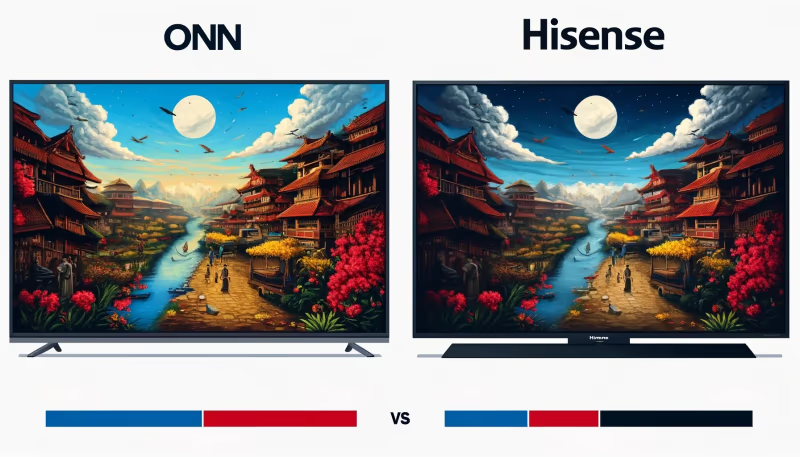
Picture performance impacts how stunning and lifelike shows, movies, games, and more will look on a TV. Here’s how image quality shakes out between these budget-savvy brands.
Resolution and Panel Type
Most Onn and Hisense TVs offer 4K resolution for sharp, detailed images. But when it comes to display panels, Hisense wins. Models like the Hisense U7H have ULED panels with quantum dots for amplified color and contrast. Most Onn TVs use more basic LED or direct LED tech.
Winner: Hisense
HDR Support
Both brands provide HDR support for expanded contrast and richer color. However, some premium Hisense models also include Dolby Vision HDR for scene-by-scene optimization. Most Onn sets only have basic HDR10.
Winner: Hisense
Peak Brightness
Brighter screens make hues pop and let you view TV clearly even in sunlit rooms. In this metric, Hisense also bests Onn with higher-end offerings hitting 1000+ nits peak brightness. Onn maxes out around 300 nits.
Winner: Hisense
Local Dimming Zones
More dimming zones allow LED TVs to fine-tune backlight levels in focused areas for truer blacks. While Onn TVs have no local dimming, mid-range and premium Hisense sets have 60-132 zones. Noticeably better contrast control.
Winner: Hisense
Viewing Angles
Onn TVs use budget IPS panels with decent off-angle viewing but color shifting. Hisense’s high-end ULED and OLED models maintain better visual integrity when viewing TV at angles. Better for large rooms.
Winner: Hisense
Motion Handling
Watching action-packed movies and sports requires smooth, blur-free motion handling. Here Onn struggles while Hisense series like the U7H perform nearly as well as premium brands, with extremely low blur.
Winner: Hisense
#Smart TV & Streaming: Onn vs Hisense
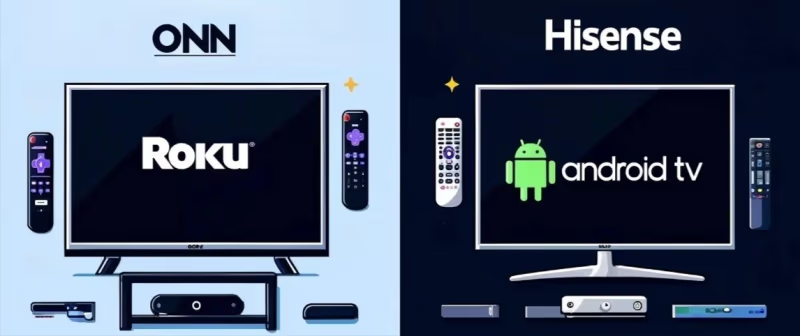
A TV’s smart platform impacts search, app selection, voice controls, streaming access and more. How do these brands compare?
Platform
As Roku TVs, Onn sets offer Roku’s acclaimed smart OS with thousands of apps and constant updates. Hisense runs on Android TV or its own VIDAA U5 platform, also with plenty of content. All solid choices.
Winner: Tie
Ease of Use
Roku TV wins points for intuitive controls and grid-style menu for easy app access. Some find VIDAA U5 more confusing with content-centric rows. Onn Roku TV black screen issues have also been reported.
Winner: Onn
Voice Assistant Support
Control TV hands-free with Google Assistant on Android TV Hisense models or Alexa/Google on Roku TVs like Onn. Voice assistant access is solid on both.
Winner: Tie
Gaming Features
Hardcore gamers, take note: Some premium Hisense TVs support gaming-friendly extras like 120Hz refresh rates, Auto Low Latency Mode (ALLM), and variable refresh rate (VRR). Most Onn models lack these perks.
Winner: Hisense
#Audio Performance: How Do They Sound?
A TV’s built-in speakers directly influence sound quality for movies, TV shows, games, and other programming. Here’s how audio stacks up between the two.
Sound Format Support
With Dolby Atmos decoding, certain premium Hisense TVs deliver immersive, theater-like 3D sound that Onn can’t match. Many Onn sets only output basic stereo audio.
Winner: Hisense
Sound Quality
While Onn TV audio is passable, it skews flat and hollow without much bass punch or clarity at high volumes. Reviewers praise certain Hisense models like the U6H for balanced, room-filling sound quality out of the box. Onn Roku TV no sound problems are also common.
Winner: Hisense
Volume
Onn TVs occasionally suffer from low max volume levels requiring a soundbar bump. Hisense TVs have no issues getting very loud, filling larger rooms without distortion or blown speakers.
Winner: Hisense
Immersive Sound Features
Some premium Hisense sets even feature integrated subwoofers and Dolby Atmos 3D audio for clear, all-around sound. Onn sets lack these advancements.
Winner: Hisense
#Connectivity & Ports: What Can You Plug In?
Available ports dictate what devices like media streamers, speakers, or gaming consoles you can connect to a TV. Let’s contrast options.
HDMI Ports
Onn 4K models have 2-3 HDMI ports while Hisense TVs usually offer 3-4. Both include at least one advanced HDMI 2.1 port for 8K@60Hz, 4K@120Hz, VRR gaming. Good future-proofing.
Winner: Hisense
USB Ports
Enjoy features like media playback or firmware updates with USB ports. Entry-level Onn and Hisense sets have 1-2 ports. High-end Hisense models provide 3-4 USB choices.
Winner: Hisense
Other Ports
Both brands offer standard ports like RF antenna inputs, composite video inputs, digital/analog audio outputs, Ethernet ports, and more. However, some users report Onn TV Won’t Connect to WiFi issues.
Winner: Tie
Wireless Connectivity
Connect soundbars and headphones wirelessly over built-in Bluetooth 5.0 support on select Hisense TVs. Most Onn models lack Bluetooth connectivity.
Winner: Hisense
#Pricing: Onn vs Hisense Television Costs
One final vital factor that distinguishes these brands is how much their TVs cost. Let’s examine pricing.
Entry-Level Models
Onn wins the budget battle with rock-bottom prices on essential, no-frills HD and 4K TVs. Expect to spend under $200 for smaller Onn sets and $300+ for larger 55″ and 65” sizes. However, be aware that Onn TV problems like flickering screens or overheating have been reported.
Mid-Range Models
In the heart of the market with feature-packed 50-65” 4K TVs, Hisense pulls ahead. The Hisense U6H and U7H series pack stunning image quality with gaming perks at just $500-800. Much better value than mid-tier Onn.
Flagship Models
If you want the best picture possible from a budget brand, only Hisense competes on the high end with QLED and OLED models selling for around $1000-2000. Onn sets max out under $500.
The Verdict? Hisense Offers a Wider Range of Prices and Features
Onn wins as the undisputed ultra-budget champ. But those wanting more size, features, and performance for the price will appreciate Hisense’s diverse tiered lineup spanning low cost to near-premium quality 4K and 8K TVs.
#The Final Call: Should You Buy Onn or Hisense?
Now for the moment of truth: Should you buy an Onn or Hisense television in 2026?
Here’s a quick recap of key pros and cons before our final verdict:
#Onn TV Pros and Cons
-
✅ Supremely low cost HD/4K TVs
-
✅ Easy-to-use Roku smart platform
-
❌ Lesser audio and visual performance
-
❌ No screen size/feature variety
However, some users report issues like Onn TVs not turning on or Onn Roku TV remote not working.
#Hisense TV Pros and Cons
-
✅ Outstanding picture quality for price
-
✅ Strong smart TV and gaming features
-
✅ Wide range of screen sizes and series
-
❌ Slightly higher prices than Onn
And the winner? While Onn is the undisputed budget king for basic TV viewing, we believe most shoppers need to take a close look at Hisense in 2026.
Hisense TVs bring premium touches like quantum dot panels, Dolby Vision HDR, better brightness, contrast control and sound into incredibly affordable price points. For not much more than an Onn, Hisense gives you a meaningfully upgraded viewing experience.
We suggest focusing your search on tiered Hisense series like:
-
Hisense U6H (mid-range stunner)
-
Hisense U7H (superb performance for cost)
-
Hisense U8H (high-end color, brightness, and gaming)
So while Onn holds the ultra-budget crown, for the best blend of value, technology, and performance in 2026 most buyers should choose Hisense. Their TVs consistently deliver impressive visuals with great smart TV platforms at prices well under premium brands.
#Frequently Asked Questions
#Is Onn or Hisense better for picture quality?
Hisense wins picture quality in every subcategory. Their mid-range and premium models use ULED panels with quantum dots, full array local dimming with up to 132 zones, and peak brightness above 1000 nits. Onn TVs use basic LED panels that max out around 300 nits with no local dimming at all.
#Are Onn TVs worth buying in 2026?
Onn TVs are worth it if your priority is spending as little as possible on a basic 4K set. You get a reliable Roku smart platform, 4K resolution, and prices under $300 for most sizes. Just know you are giving up HDR performance, gaming extras, and audio quality compared to Hisense at slightly higher prices.
#Do Hisense TVs support Dolby Vision and Dolby Atmos?
Yes, several mid-range and premium Hisense models support both Dolby Vision HDR and Dolby Atmos audio decoding. The U7H and U8H series in particular include both technologies. Onn TVs typically only support HDR10 and output basic stereo sound without Dolby processing.
#Which brand is better for gaming?
Hisense is significantly better for gaming. Premium Hisense models like the U7H offer 120Hz refresh rates, Auto Low Latency Mode (ALLM), and variable refresh rate (VRR) through HDMI 2.1 ports. Most Onn TVs are capped at 60Hz with no VRR or ALLM support, making them a poor match for PS5 or Xbox Series X gaming.
#What smart TV platform does each brand use?
Onn TVs run Roku OS, which is known for its straightforward grid-style interface and access to thousands of streaming apps. Hisense uses either Android TV (with full Google Play Store access) or its own VIDAA U5 platform depending on the model. All three platforms support major streaming services like Netflix, Disney+, and Hulu.
#How long do Onn and Hisense TVs typically last?
Both brands build their TVs to last 4-7 years under normal use, though longevity depends on the specific model and usage habits. Hisense TVs tend to have slightly better build quality and receive longer software support cycles. Onn TVs rely on Roku for firmware updates, which keeps the software current even on older hardware.
#Can you use a soundbar with Onn and Hisense TVs?
Both brands support external soundbars through HDMI ARC or optical audio outputs. Higher-end Hisense models also include HDMI eARC, which passes lossless audio formats like Dolby TrueHD and DTS-HD to compatible soundbars. Onn TVs benefit more from a soundbar upgrade since their built-in speakers produce flat, limited sound.